Tuesday, 13 November 2018

Amnesty strips Aung San Suu Kyi of 'Ambassador of Conscience' award

Source AI, 12 Nov,


Amnesty revokes honour awarded when she languished under house arrest in 2009
Rohingya in Myanmar killed and tortured in campaign of ethnic cleansing

'We are profoundly dismayed that you no longer represent a symbol of hope' - Kumi Naidoo

Amnesty International announced today that it has withdrawn its highest honour, the Ambassador of Conscience award, from Aung San Suu Kyi, in light of the Myanmar leader's shameful betrayal of the values she once stood for.

Yesterday, Kumi Naidoo, Amnesty's Secretary General, wrote to Aung San Suu Kyi to inform her the organisation is revoking the 2009 award. Half way through her term in office, and eight years after her release from house arrest, Naidoo expressed Amnesty's grievous disappointment that she had not used her political and moral authority to safeguard human rights, justice or equality in Myanmar, citing her apparent indifference to atrocities committed by the Myanmar military and increasing intolerance of freedom of expression.

Kumi Naidoo wrote:

"As an Amnesty International Ambassador of Conscience, our expectation was that you would continue to use your moral authority to speak out against injustice wherever you saw it, not least within Myanmar itself.

"Today, we are profoundly dismayed that you no longer represent a symbol of hope, courage, and the undying defence of human rights. Amnesty International cannot justify your continued status as a recipient of the Ambassador of Conscience award and so with great sadness we are hereby withdrawing it from you."

Perpetuating human rights violations

Since Aung San Suu Kyi became the de facto leader of Myanmar's civilian-led government in April 2016, her administration has been actively involved in the commission or perpetuation of multiple human rights violations.

Amnesty has repeatedly criticised the failure of Aung San Suu Kyi and her government to speak out about military atrocities against the Rohingya population in Rakhine State. During the campaign of violence unleashed against the Rohingya last year, the Myanmar security forces killed thousands of people, raped women and girls, detained and tortured men and boys, and burned hundreds of homes to the ground. Fleeing the violence, more than 720,000 Rohingya escaped to neighbouring Bangladesh. A UN report has called for senior military officials to be investigated and prosecuted for the crime of genocide.

Although the Myanmar civilian government does not have control over the military, Aung San Suu Kyi and her office have repeatedly shielded the security forces from accountability by dismissing, downplaying or denying allegations of human rights violations and by obstructing international investigations into abuses. Her administration has actively stirred up hostility against the Rohingya, labelling them "terrorists" and accusing them of burning their own homes and "faking rape". Meanwhile, state media have published inflammatory and dehumanising articles referring to the Rohingya as "detestable human fleas" and "thorns" which must be removed.

Kumi Naidoo said:

"Aung San Suu Kyi's failure to speak out for the Rohingya is one reason why we can no longer justify her status as an Ambassador of Conscience.

"Her denial of the gravity and scale of the atrocities means there is little prospect of the situation improving for the hundreds of thousands of Rohingya living in limbo in Bangladesh or for the hundreds of thousands of Rohingya who remain in Rakhine. Without acknowledgement of the horrific crimes against the community, it is hard to see how the government can take steps to protect them from future atrocities."

Amnesty has also highlighted the situation in Kachin and northern Shan States, where Aung San Suu Kyi has failed to use her influence to condemn military abuses, to push for accountability for war crimes or to speak up for ethnic minority civilians who bear the brunt of the conflicts. To make matters worse, her civilian-led administration has imposed harsh restrictions on humanitarian access, exacerbating the suffering of more than 100,000 people displaced by the violence.

Attacks on freedom of speech

Despite the power wielded by the Myanmar military, there are areas where the civilian-led government has considerable authority to enact reforms to better protect human rights, especially those relating to freedom of expression, association and peaceful assembly. But in the two-and-a-half years since Aung San Suu Kyi's administration assumed power, human rights defenders, peaceful activists and journalists have been arrested and imprisoned, while others face threats, harassment and intimidation for their work.

Aung San Suu Kyi's administration has failed to repeal repressive laws – including some of the same laws which were used to detain her and others campaigning for democracy and human rights. Instead, she has actively defended the use of such laws, in particular the decision to prosecute and imprison two Reuters journalists for their work documenting a military massacre.

Aung San Suu Kyi was named as Amnesty International's Ambassador of Conscience in 2009, in recognition of her peaceful and non-violent struggle for democracy and human rights. At the time she was held under house arrest, which she was eventually released from exactly eight years ago today. When she was finally able to accept the award in 2012, Aung San Suu Kyi asked Amnesty to "not take either your eyes or your mind off us and help us to be the country where hope and history merges".

Kumi Naidoo said:

"Amnesty International took Aung San Suu Kyi's request that day very seriously, which is why we will never look away from human rights violations in Myanmar.

"We will continue to fight for justice and human rights in Myanmar - with or without her support."

Friday, 9 November 2018

Lawyers bid to free seven Rohingya children from extended detention in Kedah

Source Malaymail, 8 Nov


Children from the Rohingya community peer out a window from the top floor of a shoplot in Selayang August 22, 2018. Seven children have been detained on arrival and transferred to the Belantik Immigration Depot in Kedah where they have remained since.— Picture by Ahmad Zamzahuri
KUALA LUMPUR, Nov 8 ― Lawyers are seeking the release of seven Rohingya children from ongoing detention by immigration authorities in Kedah that has stretched to seven months now since they arrived in Malaysia.

The children, five boys and two girls, reached Langkawi on a boat with 56 people on April 3. The boys are aged 10 to 14 while one girl is aged 14 and the other, five.

According to a news report then, the 56 people included 19 men, 17 women, 12 girls and eight boys.

According to the lawyers, these seven children detained on arrival and transferred to the Belantik Immigration Depot in Kedah where they have remained since.

"These minors who are as young as 5 years old have been in detention for more than 7 months now and attempts to access these minors by UNHCR, lawyers and family members were not successful at the time when the application was filed.

"Most of them are unaccompanied minors," the legal team said in a statement today, referring to the United Nations High Commissioner for Refugees.

Lawyers for the seven children had on September 10 filed a habeas corpus application at the Alor Setar High Court in Kedah to challenge their allegedly unlawful detention and secure their release.

The application is by the seven children against the Belantik Immigration depot's commandant, the Kedah Immigration department's director, the Immigration director-general, and the Home Ministry.

In the habeas corpus application sighted by Malay Mail, the lawyers are seeking for courts to order that the seven children be brought before the judiciary and subsequently released.

The lawyers are also seeking recognition that children's continued detention to be illegal and against their rights under the Federal Constitution, the Child Act 2001 read together with Article 22 of the Convention on the Rights of the Child.

Among other things, Article 22 states that countries who signed the convention should take appropriate measures to ensure a child seeking refugee status receives protection and humanitarian assistance. Malaysia has ratified this convention.

The lawyers also want the High Court to safeguard the seven children against rearrest or further detention due to their immigration status when they are released.

Alternatively, the lawyers are seeking that the seven Rohingya children be released from immigration detention and be placed at a children's shelter until they are reunited with their family or based on terms decided by the court.

The reasons given in the application are that the children's rights under Article 5(3) of the Federal Constitution to consult and be defended by a lawyer upon their arrest was allegedly violated, as the refusal to allow them to meet their lawyers or family allegedly amounted to an oppression of their rights to know why they were being detained and also denies their rights to challenge the detention.

The other grounds for the application include the children's detention allegedly being unlawful, irrational, arbitrary and unreasonable.

The lawyer also highlighted that the Rohingya children's indefinite detention to be invalid as they may not be deported due to their statelessness.

The habeas corpus application will be heard by High Court judge Datuk Ghazali Cha at the High Court in Alor Setar on November 11.

The lawyers for the Rohingya children are Collin Andrew, Chan Yen Hui and Lee Shee Pin, who have been working together on this case with UNHCR for free.

According to the lawyers, the Bar Council and the Human Rights Commission of Malaysia (Suhakam) are also holding a watching brief on this case.

Thursday, 1 November 2018

The EU is considering sanctioning garment workers but has rejected sanctions against Min Aung Hlaing

Source BurmaCampaignUK, 29 Oct

When the United Nations Fact Finding Mission published its report into human rights violations in Rakhine, Kachin and Shan States, it was quite clear who bore primary responsibility for violations of international law, including genocide – the Burmese military. In particular, their report called for action against the leadership of the military, including Commander in Chief Min Aung Hlaing.

To date the EU has not accepted either the findings or the recommendations of the UN investigation, which they themselves helped set up. Instead they have decided to look into sanctioning people who played no role in human rights violations against the Rohingya, Shan or Kachin. They have decided to look into sanctioning ordinary workers, mainly garment workers.

This week an EU delegation is visiting Burma as part of a review ordered by Cecilia Malmström, the EU Trade Commissioner. They are considering withdrawing 'Everything But Arms' trade privileges awarded to Burma, which reduces tariffs and makes Burma's exports more competitive than those from more developed countries. This is a sanction which will have virtually no impact on the Burmese military or on the government. Instead it risks putting tens of thousands of ordinary workers out of work.

The decision is even more extraordinary because the EU has made a specific and deliberate decision not to sanction Min Aung Hlaing. He is not one of the seven people the EU have banned from holidaying in the EU because of their role in the genocide of the Rohingya.

Here is a list of 15 things the EU has been asked to do, and which it has failed to do, all of which would be far more effective at applying pressure on the Burmese military and government than the withdrawal of trade privileges:

  1. The EU decided not to support referring Burma to the International Criminal Court.
  2. The EU does not support the creation of an alternative Ad Hoc Tribunal if support for an ICC referral cannot be secured.
  3. The EU decided not to ban EU members from training the Burmese military.
  4. The EU refuses to reveal which (if any) EU members are still training the military. (The EU ambassador to Burma, Kristian Schmidt, told Burma Campaign UK he would do so, then broke his word and now refuses to release the information.)
  5. EU officials in Burma still back down to the demands of racists and largely avoid using the word Rohingya in public statements and meetings with the government.
  6. The EU refuses to stop funding and training the military-controlled police force, which still uses torture and was responsible for arresting and framing the jailed Reuters journalists.
  7. The EU refuses to stop European companies from supplying equipment to the military (apart from arms).
  8. The EU does not ensure that the EAS/Commission and EU member states do not source goods and services from military owned and controlled companies.
  9. The EU and member states have not imposed policies to ensure no EU aid goes to military owned and controlled companies for the supply of goods and services.
  10. The EU refuses to impose sanctions limiting military owned and controlled companies' access to European financial markets and the use of the euro.
  11. The EU has not supported the findings of the UN Fact Finding Mission.
  12. The EU has not supported the recommendations of the UN Fact Finding Mission.
  13. The EU refuses to review and consider ending direct and indirect financial and technical support to the Burmese government.
  14. The EU does not support the imposition of a UN mandated global arms embargo.
  15. The EU has not stopped channelling aid and development assistance to and through the Burmese government.

It makes absolutely no sense that the European Union is considering sanctions that will mainly impact ordinary people while at the same time rejecting sanctions that target Min Aung Hlaing and his military.

At present the only sanctions from the EU in response to genocide of the Rohingya, war crimes and crimes against humanity against other ethnic groups, and a huge range of other human rights violations by both the military and the government, has been to stop seven people, not including Min Aung Hlaing or senior military officers, from going on holiday in the EU. It is, therefore, not surprising that EU sanctions have not been effective in influencing the Burmese military or government.

The bizarre decision by the EU Trade Commissioner is just the latest in its long history of catastrophically bad decision making over its Burma policy.

Through its actions and inaction from 2012, the European Union contributed to the enabling environment whereby Min Aung Hlaing believed (so far correctly) he could get away with genocide of the Rohingya.

Burma Campaign UK submitted details of British government and EU complicity in this crisis to the Foreign Affairs Committee of the British Parliament when it held an inquiry into what had taken place.

To date the European Union has done little to disabuse Min Aung Hlaing of the impression they'll keep letting him get away with violating international law, especially when they deliberately avoid sanctioning him. Does the EU seriously think that having given him a personal free pass, Min Aung Hlaing will be so concerned by the EU sanctioning garment workers that he'll change his behaviour?

As members of the European Burma Network pointed out in a joint statement: "Withdrawing these trade privileges will have a disproportionate impact on ordinary people who have played no role in human rights violations against the Rohingya and others, and in fact themselves suffer from a lack of human rights and genuine democracy in Burma."

Further, the impact of these particular sanctions on the military and government is likely to be limited compared to many other options available. It appears contradictory to impose sanctions which may predominantly impact garment workers, whilst at the same time still funding and otherwise supporting both the government and the military controlled police force.

There is a danger such sanctions could be blamed on the Rohingya, further hardening public sentiment against them. There is also a danger that these kind of untargeted sanctions and their impact on ordinary people will discredit all sanctions in the public mind and in the media, making it harder to secure support for sanctions that actually will have an impact.

Any sanctions imposed by the EU must predominantly target the military and its interests, and minimise as far as possible any impact on ordinary people in Burma.

No-one has been calling for the kind of sanctions Cecilia Malmström is now considering. Burma Campaign UK is also not aware of any EU member state supporting the withdrawal of these trade privileges. So far it appears none have been willing to publicly say so. This has to change. Cecilia Malmström may have the technical power to go ahead with these sanctions without the support of member states, but it is not a power she should use.

This review should be stopped immediately, and instead EU member states need to look again at targeted sanctions on the military, including supporting ICC referral or an alternative ad hoc tribunal. Punishing garment workers for the actions of the military is completely unacceptable, and EU member states must say so.

Perhaps the one thing we can be grateful to Cecilia Malmström for is exposing just how hopeless, contradictory and illogical the EU approach to Burma is.


Mark Farmaner is Director of Burma Campaign UK


Caught in the net: slavery on Southeast Asian seas

Source Lowyinstitute, 1 Nov,

About an hour south of Thailand's capital, Bangkok, down a dusty, broken-edged road, dotted with grimy stores and street stalls, with the incessant buzz of motorbikes, stands a desolate building complex. Turn right at the festering drain, past the guard dozing in his chair, and the dog licking itself on the pavement, if you look hard, you'll see an office.

A swarm of children race by. The disruption hardly ruffles a group of perhaps 10 young people sitting at a long table in this place known as Samut Sakhun, each with a laptop flipped up and phones in hands. It's early afternoon and the atmosphere is sleepy, the daylight is ebbing. A blue sign, "Fishermen Centre", squeaks as it swings.

In this dreary space, thousands are saved.

Here they rescue slaves.

Fishing boat off the coast of Samut Sakhun (Photo: Byron Lippcott/ Flickr)

Samut Sakhun sits in the armpit of the Gulf of Thailand. The Gulf is a vast fishing haven of some 320,000 square kilometres, washing onto the shores of Cambodia, Thailand, and Vietnam, merging with the South China Sea to the east.

Due to its relatively shallow depth, its slow flow, and robust good health, the area is rich with food sources for sea life. It is, as a result, heavily fished and regularly tussled over. Almost half of Thailand's entire seafood catch is from the Gulf of Thailand.

Important seas for Thailand. But there are global dimensions too. Thailand is the world's largest exporter of tuna and is the third biggest seafood exporter.

The spectre of slave fishermen being used to haul in the catch looms are an unavoidable problem for major buyers in the United States – the world's major consumer of imported seafood – and the European Union.

These men are held on boats at sea, sometimes for years, often beaten while working punishing long shifts for no pay.

Being such an informal and dispersed economy, its hard to nail down exact figures. Pulling together recent numbers from the Thai Department of Fisheries and estimates from local NGOs, it is likely that there are at least 17,000 fishers plying the waters of Southeast Asia who are considered slaves.

"Slaves" is the right word for these men held on boats at sea, sometimes for years, often beaten while working punishing long shifts for no pay.

A campaign to highlight this labour abuse in the Thai fishing industry has, to say the least, focused the minds of lawmakers in Bangkok. The Royal Thai Government has introduced a range of measures designed to, if not end the slave trade overnight, then at least take the spotlight of it.

The government has told all trawler owners to ensure there is adequate communications technology on every ship, and to allow all workers to freely contact families while on board. They have banned fishermen working under the age of 18 and have sought to mandate a system of electronic bank transfers for wages to enable verification that the fishermen are in fact being paid.

Most recently, it has published details of the 10,742 fishing vessels it says are registered to fish in its waters.

Despite these efforts, many men are still enslaved.

I made contact with Steve Trent from the London-based Environmental Justice Foundation after he made comments full of candour and marked by palpable frustration to The Guardian earlier this year about how the fishing industry is facing up the massive problem in its midst. 

Trent took special aim at industry groups meant to smooth the debate on a gnarly issue like slavery. Other industries who have had their feet held to the fire on labour and human rights before – toys, electronics, garments, mining, and so on – have all adopted these generally PR-fixated and corporate-funded initiatives, a bit like asbestos soles, to absorb the heat. They meet endlessly and disperse non-binding policy statements and conference papers like confetti.

Trent offered a definitive damnation of the model in the fisheries sector:

Never in my career have I seen a process more focused on talking in hotel rooms in Bangkok rather than actually committing to using their influence to create real change.

This ineffectiveness is creating gaps in the system designed to eradicate the practices of trafficking and slavery. Never ones to miss a moment, the owners of these vessels are steering ships straight into these commercial and political eddies, to ensure those waters stay muddied.

Trent told me via email that:

Pressure from vessel owners has strengthened in recent months with opposition directed at the new measures implemented by the [Thai government] … Vessel owners oppose vessel inspections and new measures designed to regulate crew working hours and ensure crews receive adequate rest time.

The size of the Thai industry alone confirms this is a global problem. Seafood produced by slave fisherman may well be in your Friday fish and chips or workday tuna casserole.

The Thai fishing sector returned export earnings of $5.5 billion in 2017, making it a major foreign currency earner for the country, where food exports account for 10% of total exports. The Samut Sakhun-based Thai Union Group is the world's leading exporter of tinned tuna.

In an attempt to establish leadership and brand differentiation, Thai Union Group publicly released a "Vessel Code of Conduct". But the policy – says a company statement – "features specifically tailored clauses for application to vessels that reflect the unique set of working conditions that necessitate special consideration." This seems to be a significant grey area.

Concerned about international trade agreements in human rights sensitive markets such the US and the EU, Thais have worked to end the trafficking and enslavement of local and migrant fishermen in Thailand.  

Meanwhile, NGOs such as the Thai and Migrant Fishers Union (known as the TMFG) have been allowed to be set up. In a country where such associations need royal assent, the very presence of the TMFG confirms the gravity of the situation. NGOs such as the TMFG, and others, monitor satellites to track ships that stay at sea for long periods, which is often a tell-tale sign that they are using slave labour. (Ships can stay at sea for years as they trans-ship their haul to larger boats, who take the produce back to shore.)

As a result, Thailand recently moved up a notch on the US State Department's Trafficking in Persons Index, which has implications for US trade agreements with countries.
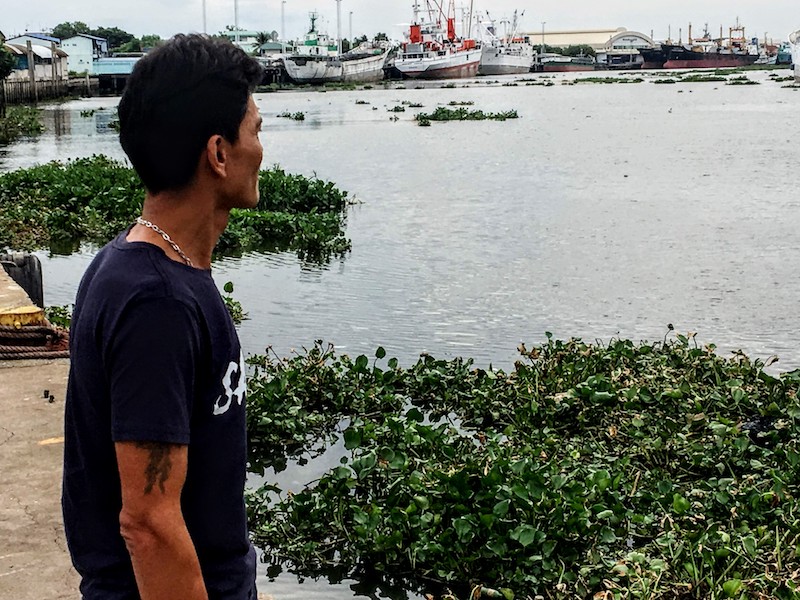
 Former slave fisherman and now rescuer, Chairat, faces danger regularly as he and his team work to bring home slaves working in Southeast Asia's fishing fleet (Photo: JJ Rose)

Inside the Fishermen Centre in Samut Sakhun, run by the Labour Rights Protection Network, Chairat Ratchapaksi enters. He has the air of a commando. Lean and wiry, he saunters into the meeting room and lopes past me like I'm a piece of furniture. This grizzled, intense air is reflexive, as I find out. Chairat is actually very helpful and willing to talk.

He is demonstrably more open than first impressions and smiles regularly. But I was never sure his eyes smiled too. 

It would be clichéd perhaps to suggest he was a coiled spring, too Robert Ludlum perhaps. But his sinewy arms, veins running like subterranean cables from a blue t-shirt with the aggressively fonted word "Savage" blaring across its chest, seemed explosive and dangerous.

His story was not unlike that of other ex-slave workers I met there, woven through with the kind of narrow, limited choices that is so often the landscape of the poverty-stricken and desperate.

His friend suggested he join up with the fishing fleet about seven years ago. It's not clear whether that friend was in on the ruse or not, but Chairat found himself stuck at sea for some years. He was unpaid, abused, and beaten, was denied rest time or holidays, could not leave or return home. Like the other testimonies I heard, this is a text book definition of slavery.
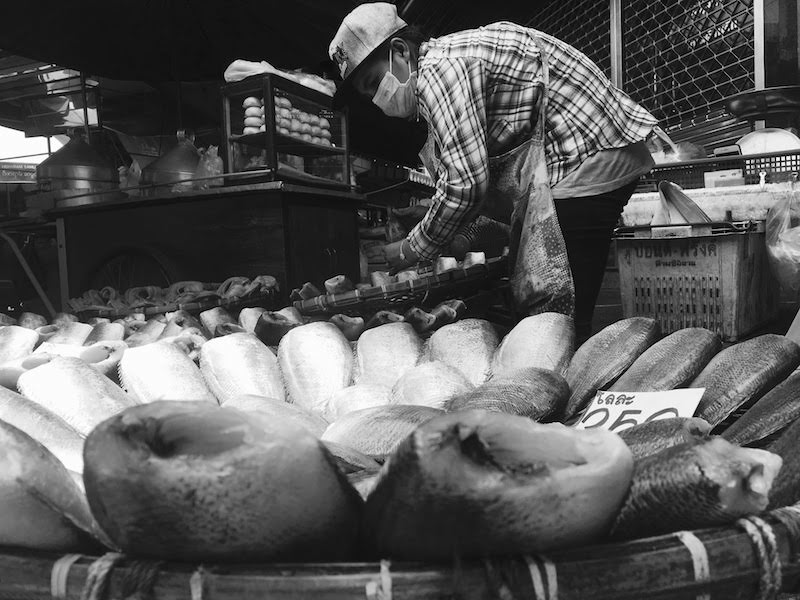
 The catch at the local Samut Sakhun fish markets (Photo: JJ Rose)

Chairat was dumped on one of the many sparsely populated islands in Indonesia. Without any papers or identification, he ended up in prison with a friend (not the one who said who suggested he go to sea), they rotted away for four months. During this time, Chairat wrote letters to the Thai government, but if they were even sent, there was no reply. He told me through an interpreter:

I felt hopeless. Lost. Who was going to rescue me? I already told the Government, but there was nothing.

There was a pause. He said the Thai word for "lost" again, and it hung there a moment. Lost, the translator eventually uttered, after a pause in which we all explored our own fears. Mono-syllabic, like the sound of something breaking.

It had seemed to me that Chairat was a man who was a little unused to such emotions. Perhaps too much is made of the stoicism of predominantly Theravada Buddhist Thais, but it is not common to see this kind of tear in the garment of faith and acceptance many Thai people wear. He seemed genuinely confused and troubled that life's evil twists, challenged his ability to bear them.

He was rescued by an act of extraordinary good luck. As part of a trip to identify discarded former slave fishermen, a delegation from Thailand, including NGOs and government representatives, was on the island. Thinking there was maybe 100 ex-slaves there, they found 1000. Someone told them about the two men in jail and they too were included, and released to go back to Thailand.

That's not even the really extraordinary part of Chairat's story however. The amazing thing is that he didn't just slink back home and hide from the world that tried to, and almost had, eaten him alive.

On the contrary, Chairat ventures back. Again and again. Chairat hasn't seen his family for a while. Now, he saves slaves.
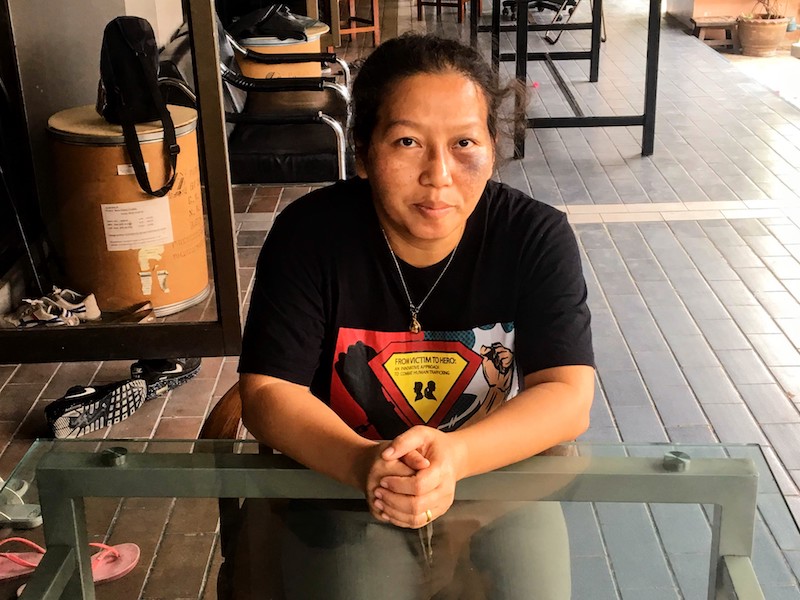
Patima Tungpuchayakul, director of the Labour Rights Protection Network, runs the Fishermen Centre in Samut Sakhon. The centre works to identify, rescue and rehabilitate slave fishermen. (Photo: JJ Rose)

Patima Tungpuchayakul ("Ms Patima") is the driving force of the group that rescued Chairat. She runs the NGO she founded with her husband in 2004, the Labour Rights Promotion Network, which was set up, says its frayed English brochur, to "advocate for equality, both in the workplace and in the community". Or as Patima put it, to provide what others could not or would not.

While its core mission is to assist migrant workers and children in Thailand – a demographic likely to increase as the gradual formation of the ASEAN Economic Community softens borders in an EU-Schengen-like move – the fact that Thai fishermen are as likely to be swept up in the slave and trafficking trade means they are working closely with Thais, too.

The Indonesian island of Benjina has become known as a place slave fishermen are sent to die.

The group's profile and work files became a lot heavier in 2014. Via migrant fishermen from Myanmar in Thailand, the NGO had heard of severe trouble occurring in the industry on the Indonesian island of Benjina. Known as "Indo-Thai" in the trade, the island, about 650 kilometres north of Australia, has become known as a place slave fishermen are sent to die.

So compelling were the claims, the group decided to investigate. Somewhat surreptitiously and carrying tourist visas, a small team, with a few journalists in tow, travelled to the island in 2014 to investigate. What they found shocked even their hardened sensibilities.

Dire, blood-encrusted cages were discovered, being used as holding pens for "recalcitrant" workers. The NGO found that some men had been enslaved under such conditions for as long as 18 years.

Men claimed that workers were beaten and abused, even murdered, to be buried in the unmarked mass grave sites dug by the prisoners themselves that dot the island.

Patima is a stout woman, a jumble of teeth often tumbling into a smile. She seems shy but not one to hide, introverted but not prepared to be quiet. Her husband, Sompong Srakaew, is a well-known human rights activist in Thailand but you get the feeling Patima is no idle follower in her husband's large footprints. Despite her discomfort at talking about herself, she carried the air of someone organised and focused, like an accountant. An accountant with boxing gloves perhaps.

In the typically chaotic office space of a busy and under-funded NGO, with children surging in and out in waves of noise, Patima explained how the system now works:

When we hear from a slave fisherman who needs our help, we have to first check his identity.

This means finding and contacting his family, verifying personal details and stories to ascertain that the call for help is not a diversion. Or a trap.

Once the person is considered a legitimate target for assistance, the authorities are contacted. This involves police, consular officials, other bodies such as the United Nations, NGOs, local figures, and community leaders. Presumably, although Patima didn't really offer an answer to this, it also involves the companies involved.

This immediately looks to be an impossibly complex and time-consuming tangle of red tape and inter and intra-office buck-passing. I get the impression from Patima that she would like to do more rescue missions, but the thicket of chits and phone calls, emails, and stuffy letterhead requests, has clearly slowed her.
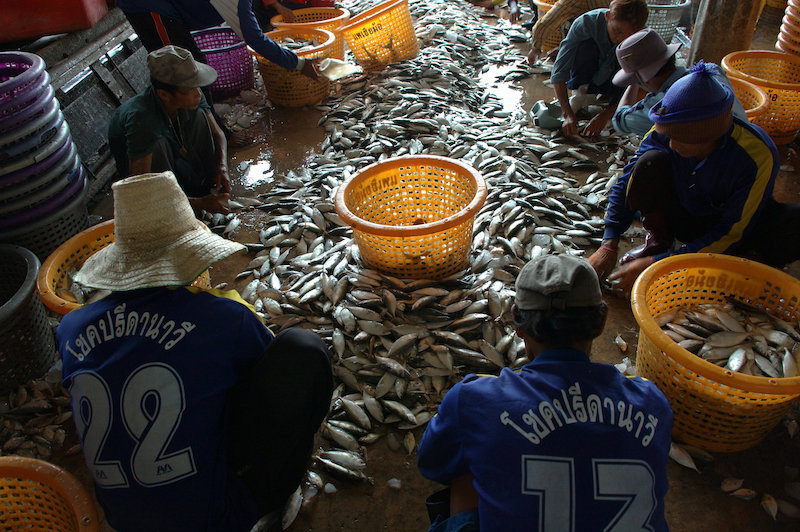
Photo: International Labour Organisation in Asia and the Pacific/ Flickr

The apparently necessary role of the fishing companies themselves, a bit of a moot point it seems, is surely a major concern.

Fishing companies control, if not effectively own, some islands in Indonesia for instance. Corrupt local authorities happily turn a blind eye to what's going on in their plot. It seems a tense political dynamic, whereby the Thai government and big local seafood companies play a kind of complicit tug-of-war, conceding and tugging as circumstances require.

Corrupt local authorities happily turn a blind eye to what's going on in their plot.

The next stage of the slave rescue process, Patima says, is to gather a posse of figures, from government to police to NGOs and media, to descend upon a location such as Ambon or Benjina and to begin finding the hapless crews, and start repatriating them.

That these operations are conducted on land, dealing with slave workers who have, in most cases, been discarded, suggests those still toiling at sea, on multi-year tenures on floating work houses, don't have much hope. There haven't been any dramatic shipboard raids on slave fishing boats for instance, of the kind seen in the Mediterranean on boats carrying refugees, a point that puts global priorities into some perspective.

Perversely, mobile phones are actually a vital tool in the slave saving game. Communications of any kind are obviously a value to those for whom such links have been severed. How slave workers manage to use phones, let alone keep their possession of them a secret, remains something of a mystery. But there are whispered rumours of a rudimentary system where slaves are told of what to do and how they can report their situation, all by phone. It's hard to see how it works. But it seems to, at least in some cases.
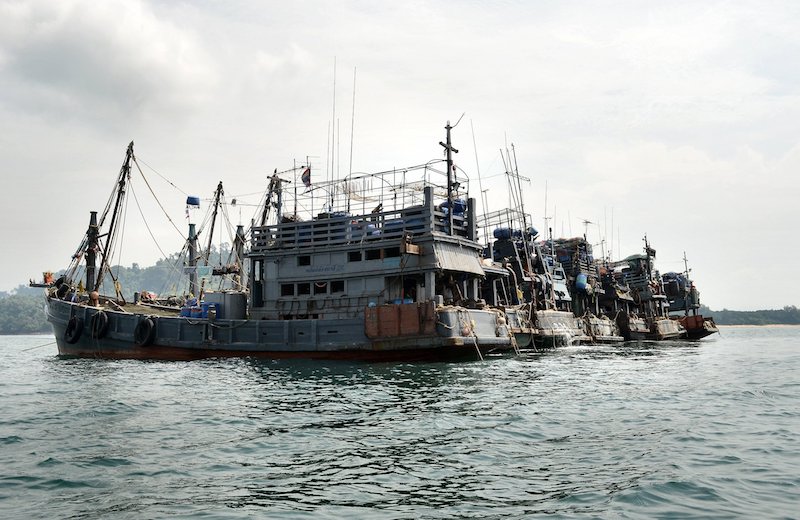
Thai fishing boats after a storm. (Photo: Runran/Flickr)

The sky was heavy in the rainy-season as Chairat and a few others whisked me off for 30 minute trip to the docks to see some of the ships involved in the slave fishing trade. A flotilla of festering hulks, rust bleeding down their flanks, were banked up in groups about the smallish harbour, not known on any map, but known to locals as Guan Yin Shrine Port.

As the tide swung seawards and vegetation floated mutely by on silver water, Chairat started pointing out ships, identifying those involved in slave labour. He points out one of the vessels: 

This one is one of ten owned by a company that uses slave fishermen.

Closer by is a colourful looking trawler, quite small and almost cheery-looking, like something from Thai travel brochure. Chairat explained these small ships were often at sea for long periods. Behind it loomed the massive presence of a "trans-ship" vessel, a dirty white behemoth the size of an office block. These bigger ships pulled abaft these smaller boats and transferred their catch, restocked, and refuelled them, allowing the smaller boats and their hapless crew to stay at sea.

Other ships lay about in a mess of nets and mud-smelly, ebb tide waters. One, which I guessed to be about 30 metres, or 100 feet, was directly opposite, on the other side of the harbor. I asked Chairat how many might work on such a vessel. I thought that only about 10 people could live, with adequate space, on such a ship. He said probably about 30 did.

"They sleep down," he said. He meant the sleeping quarters are below the decks in tight, windowless dungeons on water. The stench of crowded men, fish, and fuel can only be imagined.

It brings to mind the slave ships ambling with deadly regularity across the Atlantic in another time and a reminder of the scourge of slavery that the world struggles to eradicate.

Photo: Makus Trienke/ Flickr

Friday, 26 October 2018

Rohingya crisis: UN warns of ongoing genocide

Source Aljazeera, 25 Oct

The United Nations Fact-Finding Mission on Myanmar has briefed the Security Council on the results of its investigation into the deadly violence perpetrated by the country's military against Muslim-majority Rohingya
25 October 2018 :6 hours ago
▶
...
UN investigators say Muslim-majority Rohingya in Myanmar are still facing genocide.
The head of the United Nations Fact Finding Mission on Myanmar told the UN Security Council that up to 400,000 Rohingya who remain in Myanmar face severe restrictions and repression.
Al Jazeera's James Bays reports from the UN.

Rohingyas to be repatriated beginning next year, says Saifuddin

Source Malaymail, 22 Oct

Foreign Minister Datuk Saifuddin Abdullah (centre) meeting with Universiti Malaysia Pahang (UMP) students and staff at UMP Gambang Astaka Hall, Kuantan, October 22, 2018. — Bernama pic
KUANTAN, Oct 22 — The repatriation of the Rohingya ethnic community to Rakhine, Myanmar is likely to be implemented by next year, Foreign Minister Datuk Saifuddin Abdullah said.

He said efforts to help the community return to their homeland were initiated by the Asean Foreign Ministers' Special Taskforce led by Singapore's Foreign Minister Vivian Balakrishnan.

"This special task force will go to Myanmar at the end of this month to discuss the quickest way to help the Rohingya community return to theirs.

"We do not know how fast this process can be implemented, but it should be initiated, for as ong as it does not start, the problem involving the Rohingya refugees will persist.

"It is important for us to help these people return to their home country, as otherwise, it would be condoning the 'ethnic cleansing' which is currently happening," he told a press conference after opening the Kuantan District Malay Language Teachers Professionalism Enhancement Workshop at the Pahang State Library Corporation here, today.

Saifuddin, who is also Indera Mahkota MP, said among the actions expected to be implemented by the special task force was to set up a monitoring team to ensure the safety of the Rohingya community in Myanmar.

He said the existence of the team was important as the Rohingya people feared to return due to the oppression.

Security risks have also left about one million Rohingyas stranded in Bangladesh, where the Malaysian Government has also assisted through the setting up of field hospitals in the Cox's Bazar Region.

"While the Rohingyas in Malaysia have been helped in terms of their children's education, without involving government funds, as it is being implemented through of non-governmental organisations (NGOs).

"So far there have been six NGOs who have set up child education centres for Rohingyas, relying on their own funding or international donations such as from the Qatar Foundation, which helps in the sponsorship of welfare and education," he said.

Saifuddin also informed that the Human Resources Ministry had also tried to help the Rohingya community, however, the pilot programme involving 300 people was unsuccessful.

"Maybe the job provided was not appropriate or the method used... so the ministry involved is looking for a way to help them get jobs," he said.

He added that Malaysia will continue to urge for those involved, including several high-ranking Myanmar military officials to be held accountable for the Rohingya crisis.

Defence Minister Mohamad Sabu yesterday said there were over 100,000 Rohingya refugees in Malaysia, and not all of them were registered with the United Nations High Commissioner for Refugees (UNHCR). — Bernama

Nine U.N. Security Council members ask to discuss Myanmar inquiry

Source Reuters, 17 Oct

UNITED NATIONS, Oct 16 (Reuters) - The chair of a United Nations inquiry that accused Myanmar's military of genocide is likely to brief the Security Council this month after Britain, France, the United States and six other members requested the meeting, diplomats said on Tuesday.

The move comes as global pressure mounts on Myanmar to act on accountability after a Myanmar military crackdown in the western state of Rakhine last year drove some 700,000 of the largely stateless minority over the border into Bangladesh.

The crackdown followed attacks by Rohingya militants on security posts. Myanmar has denied committing atrocities against the Rohingya, saying its military carried out justifiable actions against militants.

The U.N. inquiry's report, released in August, called for the U.N. Security Council to impose an arms embargo on Myanmar, impose targeted sanctions and set up an ad hoc tribunal to try suspects or refer them to the International Criminal Court.

Diplomats say council veto powers China and Russia are likely to protect Myanmar from any push for such measures.

However, they cannot block the briefing on the U.N. report because a minimum nine of the 15 council members support the move, which cannot be vetoed. Diplomats say China and Russia believe the report should first be addressed by the U.N. General Assembly's Third Committee, which deals with human rights.

The letter requesting the briefing was signed by Britain, France, the Netherlands, Sweden, Poland, Peru, Kuwait, Ivory Coast and the United States.

SPONSORED STORIES

Myanmar's U.N. Ambassador Hau Do Suan wrote to the Security Council on Tuesday to object to the chair of the inquiry being invited to brief the body, warning that it "will only exacerbate mistrust and polarization among different communities in Rakhine" state, where the military crackdown occurred.

"Putting accountability above all else without regard to other positive developments is a dangerous attempt that will face utter failure," he wrote.

The U.N. inquiry, established by the Geneva-based U.N. Human Rights Council, said the military carried out mass killings and gang rapes of Rohingya with "genocidal intent." Myanmar rejected the findings as "one-sided" and said it was a legitimate counterinsurgency operation.

The European Union is considering trade sanctions on Myanmar over the Rohingya crisis, potentially stripping the country of tariff-free access to the world's largest trading bloc, three EU officials said earlier this month. The EU has already imposed travel bans and asset freezes on several military members.

The United States imposed sanctions on four military and police commanders and two army units in August. New sanctions are under consideration for half a dozen other individuals and at least two military-run businesses, U.S. officials have said.

"Unilateral coercive measures without regard to the situation in Myanmar and imposition of politically motivated external pressure will be detrimental to the existing good will and cooperation of the Myanmar Government with the international community," Myanmar's U.N. envoy wrote to the Security Council.

Separately, the prosecutor of the International Criminal Court has begun examining allegations of forced deportation of Rohingya to Bangladesh. Myanmar has said it wants to repatriate Rohingya who fled. (Reporting by Michelle Nichols Editing by Paul Tait)